
Election Diary
Il Sorpasso

Long ago, possibly as long as three weeks ago, we heard a lot from the Tories about how the election came down to a simple choice - who would occupy 10 Downing Street? It could only be Sunak, or Starmer. That attempt at framing the election as a presidential battle between ‘float like a butterfly, sting like a bee’ Sunak, and ‘Sleepy’ Starmer, the snoring boring chap, was coupled with the seemingly confident prediction that the polls would inevitably narrow as the day of decision loomed.
But then came a new fear. The return of Nigel Farage, and the spectre of ‘il sorpasso’ - the overtaking. Could Reform UK, under the leader with superpowers, actually push the Tories into third place in the vote share, if not in seats won?
Last Friday saw the first, and so far the only poll to put Farage’s latest electoral vehicle ahead of the Tories by one point. That’s well within the margin of error. But it was enough to terrify those running the Tory campaign.
A few days before that poll John Curtice had described Farage’s re-entry into British electoral politics as “an event, not a process”. The poll uptick at that point was small, and did not suggest a boost to Reform’s trajectory in the polls. And yet, at the moment Farage is being treated by the media not as a political old timer leading a fringe party, but as the big story. Why is this happening?
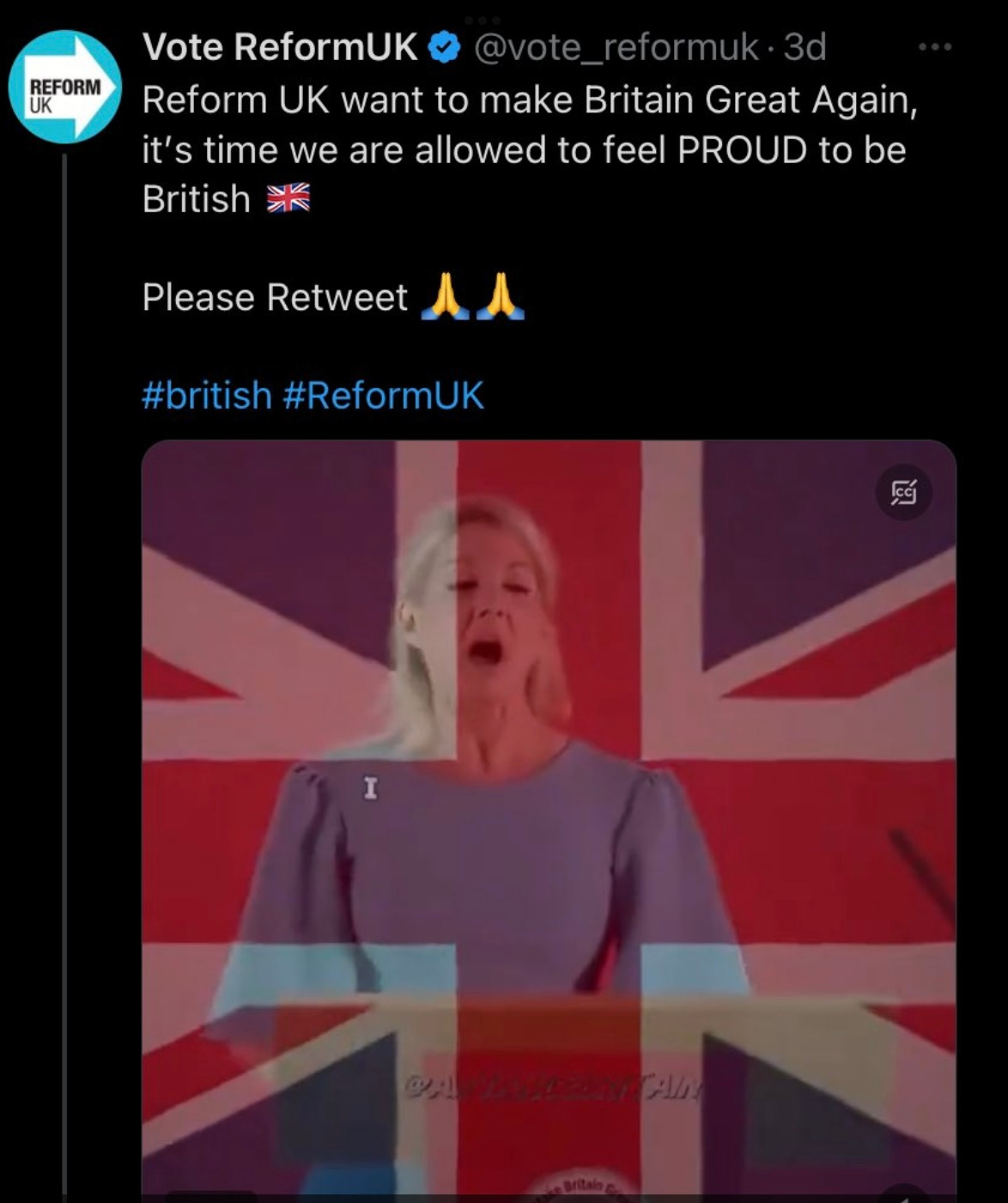
The truth is that the media is bored. The Tory story writes itself, from the rain-soaked launch, to the D Day disaster. Meanwhile the ‘Ming vase strategy’, coupled with the discipline of a party seemingly run by the Spanish Inquisition has made the Labour campaign into a bland and colourless thing. Lib Dem high jinks in the water, or on the scary rides at fun fairs, only goes so far to stave off the tedium.
Whereas Farage is there, ready, available, and willing, or should I say eager, to offer pungent opinions in easily clippable, quotable form.
I hadn’t expected to feel the need to say anything much about Farage and Reform UK. Especially after watching the first seven way TV ‘debate’, an excruciating circus and an insult to voters, I thought that Farage was dead on arrival. He was the old hand, the guy who’d done this before. His face was the familiar face, the politician’s politician. He’s got a certain slick patter, essentially identical to that of Tice, but like an old school comedian whose act was honed in working men’s clubs, Farage has his delivery pitch perfect, seemingly light, but with an unmistakable undertone of dark menace. But it’s yesteryear’s act. No one will be booking him for Jongleurs anytime soon..
The lack of applause from the studio audience seemed to surprise Farage. The delight he elicits in news meetings is not so evident on contact with a representative sample of the public.
Any yet, reluctantly I’ve concluded that he might still matter. Reform’s electoral reach might have quite a low ceiling, but it’s not a negligible one. And the Farage sequel to his previous hit disaster movie, Brexit, looks likely to be nastier than the original.
Along with his fans in the once respectable Conservative Party, Farage’s mission is to sow poison and division, and to mobile latent hatreds for political ends. We see it clearly in vox pops from ‘Red Wall’ constituencies, as mostly elderly men and women, some clearly already well down a YouTube rabbit hole of conspiracy, speak fondly of Enoch Powell, but with a strong contemporary dose of Douglas Murray thrown in.
David Cameron was given a little license to slap this talk down, but he doesn’t speak for his party any longer. And Labour is plainly not keen to say anything that might not sound hard line on immigration. Herein lies the danger. Letting things once deemed unacceptable in polite company (and on TV screens and other devices) back into the political mainstream won’t neutralise the poison, it will spread it.
There’s something else that Farage gets away with. He says he wants to destroy the Tory Party. But only to become it.
Think about that. Polls show that people are sick of the Tories. Specifically they are fed up of their incompetence, their inability to deliver what they promise. The loud talk, the swagger, the parade of austerity, Johnsonian hyperbole and epic lack of seriousness, Truss’s costly pantomime of delusion, and Sunak’s dithering (Dominic Cummings’ personal pick for Chancellor turns out to be the real ‘trolley’, veering from side to side of the aisle is the desperate hope of finding something, anything that works). But Farage is part of that line up. He exemplifies the things that people are sick of. And that needs to be spelled out fast.
Farage is a pure politician because he lacks any real interest in policy, still less in governing. He is all the Tory leaders since 2010 tolled together (with the honourable exception of Theresa May, who wasn’t a good or effective PM, but at least tried to govern, and has some landmark legislative achievements to her name). Farages’s public persona is utterly Johnsonian, all fake bonhomie and total fixation on personal gratification. His beliefs, such as he has them, are pure Truss.
Labour, it seems, is serious about competent administration, about reforming government so that it works. But if the party gets into power, it will still need to communicate, and via a shallow, mostly hostile media. It will be too easily thrown off course if it doesn’t use the space of this election campaign to neutralise the mischief making potential of the Faragistes by ensuring that they are widely seen as party to the project of the Brexit Tories, and jointly responsible for the disastrous conduct of government over the last 14 years.
Well said. We need more politicians as teachers- Blair was good in his initial LOTO and first term as PM