
Election Diary
What are the odds on that happening?

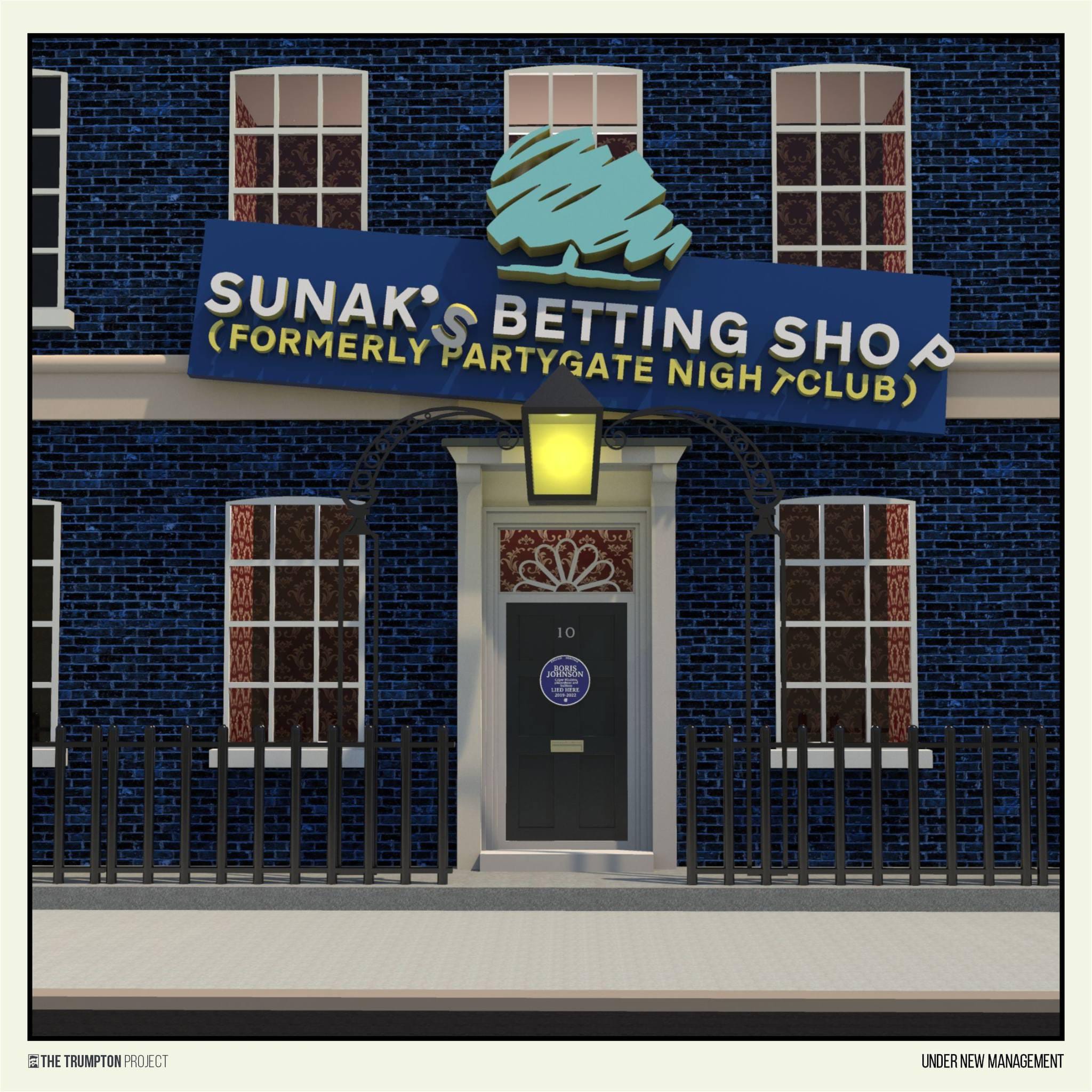
Social media meme from Trumpton
It’s hard to keep an election diary when it’s less a matter of following the campaign, more one of trying to keep your bearings on a runaway train. When last I posted, I thought I’d wait until the BBC Leaders’ Question Time to assess where we were. Now that seems barely worth mentioning.
The other aspect of the campaign that had been worrying was the capacity of the media to make the candidacy of the owner of a fringe party into one of the biggest stories of the election. Perhaps there is less reason to be concerned about Farage and Reform UK now - and not just because revealing himself as an apologist for Vladimir Putin in an interview with the BBC was, let us say, unwise.
For there is only one story at the moment. The Tory betting scandal.
At the start of this campaign, as Rishi Sunak stood in the pouring rain to announce the date of the general election, I wasn’t alone in wondering whether I was watching a drama scripted by Armando Ianucci. It’s a feeling that grows with each plot twist. The storylines are both jaw-dropping and somehow wholly expected. All power corrupts. And then there’s Paddy Power….
For those who have been too busy watching the Euros to follow the Tory Party’s current woes, the independent Gambling Commission is reportedly investigating a number of Conservatives (the Tory Campaigns Director, Tony Lee and his wife, Tory prospective parliamentary candidate Laura Saunders, Nick Mason, Conservative Chief Data Officer, and former Welsh MP and PPC, Craig Williams) for allegedly placing bets on the date of the general election shortly before it was called. There is also speculation in the media about whether other names are under investigation, because the sudden spike in betting on a July election was sufficient to arouse suspicion.
This is a particularly difficult issue for the party still in power to handle for several reasons. It is dominating the news - and the radio phone-ins, and comedy shows - just as the final full week of the campaign kicks off. Unlike many political scandals (Owen Paterson and parliamentary rules, PPE procurement?) it is not a complicated issue; like Partygate, anyone can grasp it. And above all, it has the ‘feel’ of the kind behaviour that the public has come to expect from the Conservatives.
And yet, I have a small but persistent feeling, no more than that, that Gamblegate, as inevitably it has been called, is a silver lining for the Tories.
Yes, it looks sleazy. Fingers in the till, on the make, noses in the trough. It stinks. That rank smell, however, is a familiar one. Most voters repelled by it made their minds up a long time ago. 2022, to be more precise. That’s when Liz Truss’s brief premiership happened, and the gulf in polling numbers opened up between the Tories and Labour that this campaign has done nothing either to widen, or to narrow. Perhaps a few more Tory voters will conclude that they’ve been holding their noses too long, and jump, but probably not many.
Yet the scandal has had the effect of directing the spotlight away from their nemesis on the right. And surely that’s a kind of win for the Tory Party?
For Farage is doubling down on his stance on Putin, Ukraine, NATO, and, inevitably, the EU. He’s also continuing to hawk his anti-NHS position of advocacy for a ‘French-style’ health insurance system. On the face of it, these are not obviously popular or even populist positions in the U.K. Why would the Reform UK owner want to put clear black water between his outfit and the Tory Party?
The answer is obvious if you listen to what he’s saying. Forget the pub bore manner, the excitable fan base, the indulgent media. Farage spearheads a plan, one might even dub it a plot, to move politics in Britain much further right. He is serious about this, and after his success with Brexit is in no mood to coast, especially as his hero across the Atlantic looks poised to regain power. But if old school Tories can’t or won’t confront the dangers of Farargism, there are others who will. They just aren’t in the Conservative Party, or its media wing.
Sunak is too weak, too compromised to resist. There are too many in his party who either admire the swaggering aggression of Farage’s style, or who actually share his worldview. So anything, anything at all that reduces the campaign noise around Farage must be objectively a ‘good thing’ for Sunak. Of course, there’s still just over a week to go, and anything - freak asteroid hit on Clacton, mass escape of lions from Longleat, gunfight between Lee Anderson and Gloria di Piero in Ashfield - just anything could happen.
Which obviously brings us to the polls.
There seem to be more polls than ever in this election. But no one’s interested in the old bog standard opinion polls, the sort that questioned a representative sample of 1500-2000 voters and gave us some headline numbers. These days it’s got to be a multi-level regression or MRP poll. These are the polls which take very large samples of voters and project the results onto the constituency map of Britain to estimate the seat share the parties might get. The infographic below from YouGov is in the middle range of MRP polls in showing the Tories getting an eye-wateringly low number of seats (nearly half of Labour’s disastrous 2019 tally), but still over 100 seats. Other polls have gone as far as to suggest that the Liberal Democrats could beat the current governing party into third place.
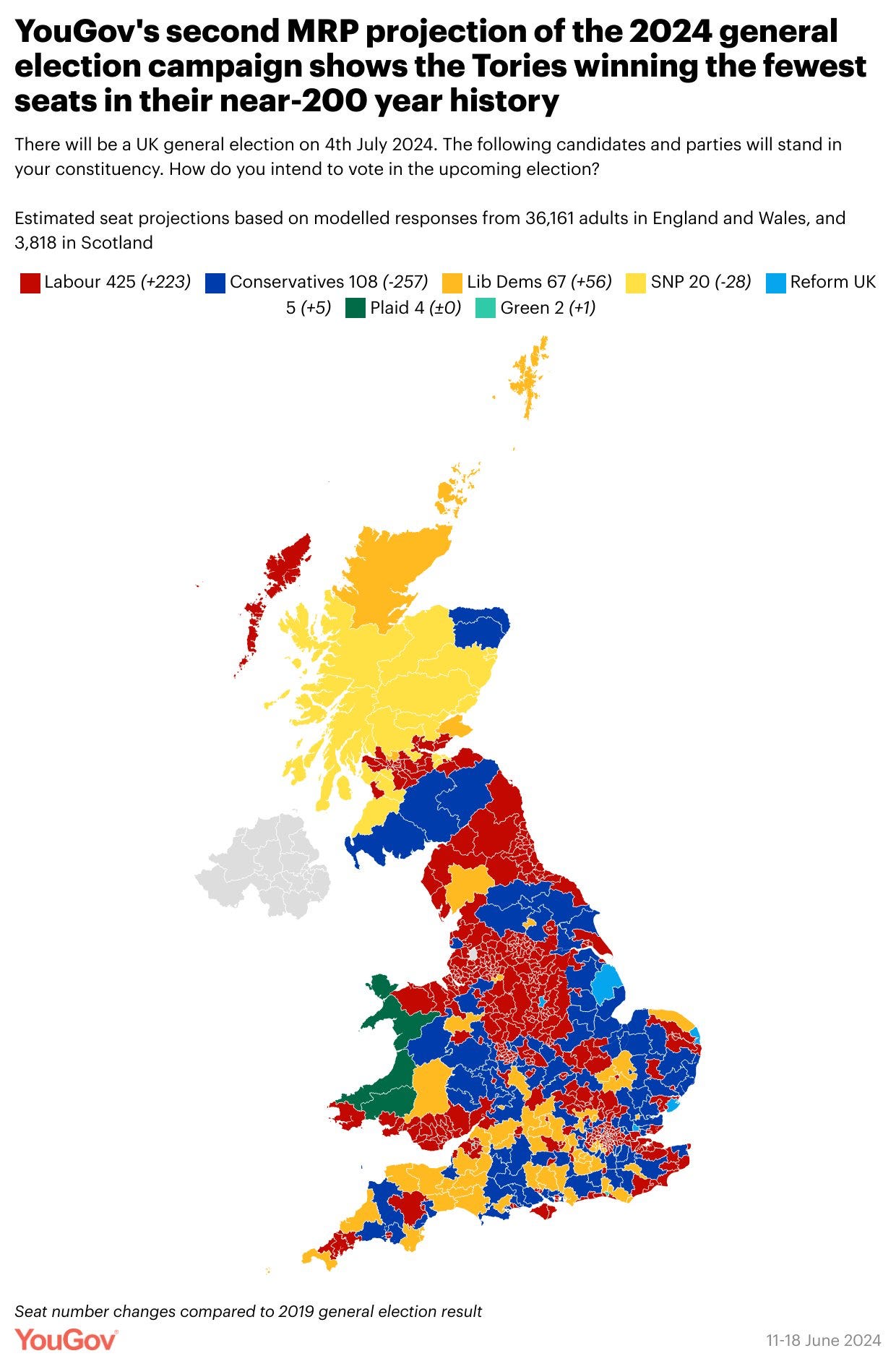
These numbers are so unlike anything we have ever seen before, and they vary so wildly that it is hard to believe that any of them can be correct. And yet the record of MRPs - so far - has been good enough for us to take seriously the likelihood that the Tories are in deeper trouble than they’ve ever been since universal suffrage.
In any case, it is poor etiquette to talk about polls without referring to Professor Sir John Curtice. His advice is excellent - don’t obsess too much about the numbers, look at the trend. And the trend, if it can be called a trend, is that the gap between Labour and the Tories remains steady, but the fracturing of the vote on the right is what could make projections like the one above a realistic possibility.
Which means that Labour could win a landslide on a lower share of the vote than they got in 2017.
Please gamble responsibly.